
Botree DMS
Streamline distribution and boost primary sales efficiency.

Botree FlexiDMS
Access secondary data seamlessly without daily disruption.

Botree MyDMS
Empower distributors and accelerate rurban market growth.

Botree SFA
Boost sales productivity and ensure in-store excellence.

Botree Retailer App
Enhance retailer engagement with modern mobile app.

Botree AI
Make smarter decisions with granular insightful dashboards.

Christina Evangelin Ebinezer
Marketing AssociateUpdated on June 6, 2026



Just enter any pharmacy in India and you will see how many OTC products are sold there without the backing of a prescription. Painkillers, antacids, cough medicines, and vitamin supplements compete purely on visibility, reputation, and the last level of servicing by the wholesaler.
This is the OTC pharma sales reality, and it is entirely different from B2B sales pipelines that many generic SFA applications are intended for.
Nevertheless, quite a few OTC pharma businesses continue to rely on such generic SFA software as their main instrument for field sales automation despite all its inherent disadvantages.
Here we discuss the reasons for such a discrepancy and how an OTC Pharma SFA` Software will differ from a generic one.
The Pharma SFA, which stands for Pharma Sales Force Automation, is a field sales management solution designed exclusively for pharmaceuticals and Over the counter (OTC) pharma firms. It assists in planning beats for chemists, managing doctor/pharmacy visits, registering secondary sales, implementing schemes, ordering, and capturing field activity.
By eliminating the need for traditional DCRs and spreadsheet methods, Pharma SFA allows the organization to gain visibility on field performance with just one application.
In the case of an OTC pharma firm, whose success lies in chemist coverage, product availability, and on-ground performance as opposed to prescriptions, the Pharma SFA acts as the backbone of their entire sales process.
The reason behind OTC pharma firms needing a specialized Pharma SFA can only be comprehended by analyzing the difference between OTC sales and prescription pharma sales.
Whereas, in prescription pharma, doctors are the major customers, in OTC pharma, there are no prescriptions at all. Instead, the chemist is the customer and the point of influence, where field sales staff needs to ensure that products are made available, trade schemes are communicated, space for the products on shelves is secured, reordering and awareness creation are ensured.
The chain in OTC sales is Salesperson → Stockist → Chemist → Consumer.
It’s the very difference in the sales process that makes the need felt for an advanced, specialized Pharma SFA.
A generic SFA is not built for any of this. It tracks leads, manages pipelines, and logs meetings. It has no concept of a chemist beat, secondary sales visibility, or in-store shelf compliance.
As OTC pharma operations grow, managing field execution becomes increasingly complex. Sales teams must cover thousands of outlets, coordinate with distributors and stockists, execute trade schemes, track secondary sales, and maintain retail visibility across multiple territories.
Without a Pharma SFA, these activities are often managed through spreadsheets, phone calls, WhatsApp messages, and manual reports. While these methods may work at a smaller scale, they create significant challenges as the business expands.
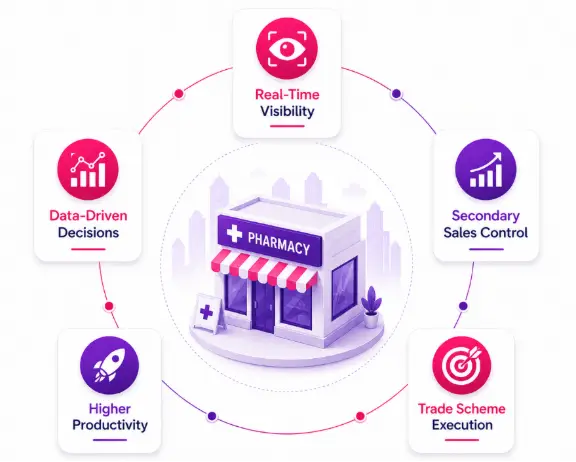
Sales leaders need to know what is happening in the market today, not at the end of the month. A Pharma SFA provides real-time visibility into outlet coverage, field activities, sales performance, and execution quality.
For OTC pharma companies, secondary sales are often a better indicator of market performance than primary sales. Pharma SFA helps track product movement across distributors, stockists, and retail outlets, enabling faster and more informed decisions.
Trade schemes and retailer incentives are only effective when they are executed correctly. A Pharma SFA helps standardize communication, reduce errors, and improve scheme compliance across the channel.
As businesses grow, increasing coverage should not always require adding more field teams. Pharma SFA helps improve planning, route efficiency, and execution consistency, allowing organizations to scale more effectively.
Instead of relying on delayed reports and fragmented information, managers gain access to accurate, real-time data that supports faster and better decision-making.
Most generic SFA platforms were designed to improve sales productivity. OTC pharma companies need platforms that improve market execution. That difference becomes obvious in day-to-day field operations.
Generic SFAs work on an account and opportunity basis. OTC field teams plan their actions using beats, coverage plans, and route plans. These aspects need much more sophisticated planning and monitoring.
Without insights into secondary sales, product movement between distributors and chemists, managers have to rely only on data about primary sales that do not say anything about market demand.
Pharmacy, supermarket, dispensary, and stockist have unique roles in the OTC value chain. Yet generic SFAs offer the same workflow regardless of their different tasks.
Scheme communication, retailer incentives, and stockist programs may be managed outside the system via emails, spreadsheets, and WhatsApps due to the lack of corresponding tools.
Generic SFAs are able to tell you which places reps visited. But they are unable to inform about secondary sales, product availability, visibility, and shelf placement against the competition.
The difference is simple: a generic SFA helps teams record activities, while a Pharma SFA helps OTC companies manage and improve field execution.
| Capability | Generic SFA | Pharma SFA |
|---|---|---|
| Primary Focus | Opportunity and pipeline management | Field execution and market coverage |
| Territory Management | Increased stockout risksBasic account allocation | Beat planning, route optimization, and outlet coverage |
| Outlet Management | Standard customer records | Pharmacy, chemist, stockist, hospital, and retail-specific workflows |
| Secondary Sales Visibility | Limited or unavailable | Real-time visibility into secondary sales performance |
| Scheme Management | Typically managed outside the platform | Built-in scheme communication and execution tracking |
| Field Activity Tracking | Visit logging and reporting | Geo-validated visits with execution insights |
| Retail Execution | Minimal support | Shelf audits, visibility checks, and compliance tracking |
| Distributor Coordination | Limited integration | Connected distributor, stockist, and field operations |
| Analytics | Historical activity reports | Execution, coverage, and performance insights |
| AI Capabilities | Basic dashboards and reporting | Outlet prioritization, coverage recommendations, and predictive insights |
For organizations focused on pharmacy coverage, secondary sales growth, trade scheme execution, and retail visibility, that distinction can have a direct impact on market performance.
A purpose-built Pharma SFA helps OTC pharma companies improve visibility, strengthen execution, and manage field operations more efficiently. Here are some of the key capabilities that set it apart from a generic SFA.
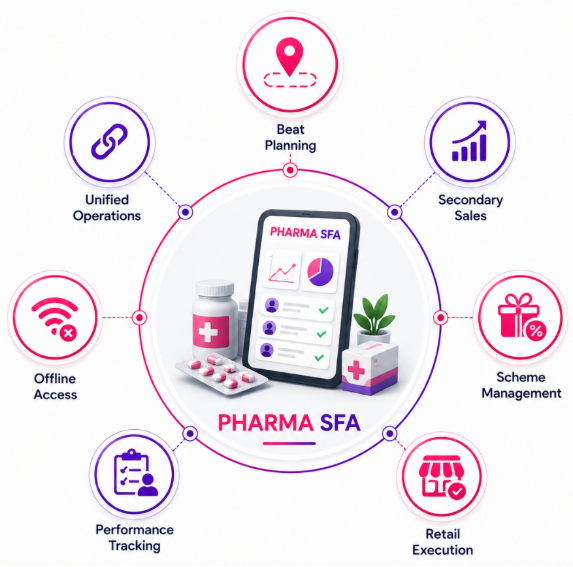
Strategic beat planning and routing optimizations ensure that the field staff reaches the right retailers at the right frequency without wasting time traveling. This enhances market coverage and leads to productive calls as well as consistency by sales managers in territory execution.
Through secondary sales visibility companies can see the real movement of the products within an outlet instead of depending on the information provided by the distributors alone. This helps sense demand effectively and make better inventory decisions.
Built-in scheme management ensures promotions and retailer incentives are communicated and applied consistently across the distribution network. This reduces scheme leakage, improves channel trust, and helps maximize the return on trade investments.
The use of image audit and retail execution solutions can track product placement, availability, and promotional adherence at different stores. The increased visibility in terms of products will improve brand presence, availability, and conversions of purchases made by customers.
With digital visit reports, tours, and activity trackers, management can have visibility on field work being done. Increased visibility will ensure accountability, reduced effort from reporting, and quicker interventions in case of any discrepancies in performance.
Offline capability allows for visits to be recorded even in low internet zones. This will improve the efficiency of field work because all field activities will be fully monitored and captured.
Through use of one system that tracks OTC sales as well as RX sales operations, businesses will have visibility on their field operations such as pharmacy coverage, doctors’ visits, sampling, and overall field execution of sales activities.
Deploying a purpose-built Pharma SFA delivers measurable business outcomes across the OTC sales operation.
Botree SFA is designed to meet the specific requirements of OTC pharma sales. It helps pharmaceutical firms optimize field execution and get a complete grasp of their sales operations in real time through capabilities such as chemist coverage, secondary sales management, trade scheme execution, and distributor visibility.
Botree offers the following features and capabilities:
With all these functions under one roof, Botree Software helps OTC pharma firms optimize outlet coverage, productivity, and ultimately sales performance.
OTC pharma sales is an execution-oriented industry. To succeed in it requires consistent outlet presence, proper execution of trade schemes, secondary sales visibility, and coordinated efforts among distributors, stockists, and chemists.
Where generic SFA applications help companies automate routine sales tasks, their use does not factor in the unique challenges faced by OTC pharma in the field. With specialized Pharma SFA, businesses get the means to improve visibility, execution, field productivity, and speed up decision-making using data.
With competition and evolving consumer demands, OTC pharma companies require a solution that goes beyond tracking of sales activities. The companies require a specialized solution that will enable them to execute their sales across the distribution chain.
It is not about whether your sales force needs to be automated, but rather, whether your current SFA application supports OTC pharma sales execution.
Marketing Associate
Meet Christina Evangelin Ebinezer, our dynamic marketing associate at Botree Software. With a background in HR and marketing, and prior experience as a content writer, Christina brings a sharp eye for storytelling and a knack for crafting engaging blogs and marketing content. She’s passionate about turning ideas into words that drive impact. Outside of work, Christina finds joy behind the piano keys or the wheel—whether she’s playing a soulful tune or cruising down open roads.
What is Pharma Sales Force Automation and how does it help OTC companies?
How is Pharma SFA different from a Pharma CRM?
Why are field visibility and sales force tracking important in OTC pharma?
How do route optimization software and territory management improve field productivity?
Can Pharma SFA support secondary sales, scheme management, and order management?
What features should companies look for in Pharma SFA software?



Stay updated with the latest trends and insights.