
Botree DMS
Streamline distribution and boost primary sales efficiency.

Botree FlexiDMS
Access secondary data seamlessly without daily disruption.

Botree MyDMS
Empower distributors and accelerate rurban market growth.

Botree SFA
Boost sales productivity and ensure in-store excellence.

Botree Retailer App
Enhance retailer engagement with modern mobile app.

Botree AI
Make smarter decisions with granular insightful dashboards.

Christina Evangelin Ebinezer
Marketing AssociateUpdated on August 18, 2026



Imagine an FMCG brand introducing a new product in 20 cities.
There is a demand for it. The marketing campaign has been launched. Retailers are interested in it. But the brand has another issue at hand – its own sales force simply cannot service all the neighbourhoods, process orders, maintain retailer relationships, keep the goods stored near each market and ensure its presence in thousands of retail stores.
The brand decides not to undertake this task alone. It collaborates with existing distributors familiar with the market, sales forces serving the local outlets, wholesalers expanding its reach further and retailers stocking its products for consumers.
Another company in the IT industry will find its solution in collaboration with resellers or implementation partners which already possess access to the target customers.
Different industries, different partners, the same business principle – grow through your partners.
This guide explains the meaning behind channel sales, different models and partners used, the role of channel sales in FMCG distribution, measurement of channel performance, origins of channel conflict and how technology assists businesses in managing increasingly complex channel networks.
Channel sales are also referred to as indirect sales because the selling company does not sell directly to the buyer. The product or service passes through at least one intermediary before reaching its final customer.
Channel sales is the practice of selling through intermediaries rather than through an internal sales team going directly to the end customer. Those intermediaries – the channel partners – take on some or all the selling, distribution, and customer relationship work in exchange for a margin, a fee, or a commission.
Channel sales is most often associated with B2B, where technology companies, manufacturers, and service providers use resellers, distributors, and partners to expand their commercial reach. However, it also applies to B2C—especially in FMCG and consumer goods, where brands sell to distributors, distributors sell to retailers, and retailers sell to consumers. While B2B and B2C channel sales operate differently, the core principle is the same: reach more buyers through partners than your own team could reach alone.
In direct sales, the company sells straight to the end customer – through its own sales force, its website, or its own retail locations. In channel sales, one or more intermediaries sit between the company and the end customer. The company sells to the partner; the partner sells to the customer.
Direct Sales vs Channel Sales
Many businesses use both models simultaneously – direct for strategic accounts or high-margin segments, channel for broader market coverage. The choice is not binary.
| Dimension | Direct Sales | Channel Sales |
|---|---|---|
| Who sells | Internal sales team | Third-party partners |
| Customer control | High – brand owns relationship | Lower – partner manages customer |
| Margin | Higher – no channel margin shared | Lower – partner margin reduces brand’s take |
| Speed of expansion | Slower-requires internal hiring | Faster -leverages partner’s existing reach |
| Customer data visibility | Full visibility | Partial -depends on what partners share |
| Cost structure | Higher fixed costs (headcount) | Lower fixed costs, higher variable |
| Scalability | Scales with headcount | Scales with partner network |
This is the distinction that most channel sales content misses -and it is the most important one for anyone in FMCG, CPG, pharma, or physical goods distribution.
Channel sales operate through two structurally different models. Both are channel sales. But their operations, KPIs, partner relationships, and management requirements are almost entirely different.
Model 1: Partner-Led Channel Sales
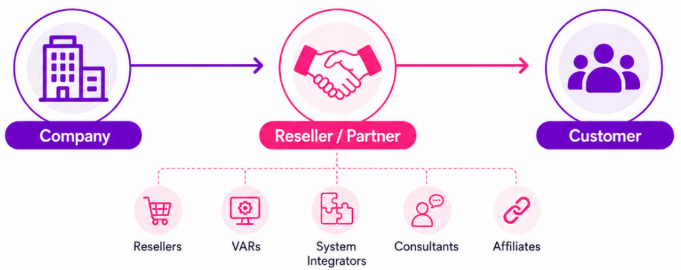
This is the model most technology and B2B software companies use. The company recruits and enables third-party partners -resellers, value-added resellers (VARs), system integrators, consultants, or affiliates -who sell the company’s product to their own client base.
Typical flow: Company → Reseller/Partner → Customer
Common in: SaaS, enterprise software, IT hardware, professional services, insurance, telecommunications.
How it works: The partner typically has an existing client relationship and recommends or sells the company’s product as part of a broader solution. Deals are often registered, tracked through a partner portal, and measured by revenue sourced or influenced.
Model 2: Distribution-Led Channel Sales
This is the model that governs how FMCG brands, CPG companies, pharma manufacturers, and consumer goods businesses move products from factory to shelf. The company does not sell to the end consumer – it sells to a network of channel partners who progressively distribute the product downstream until it reaches the shopper.
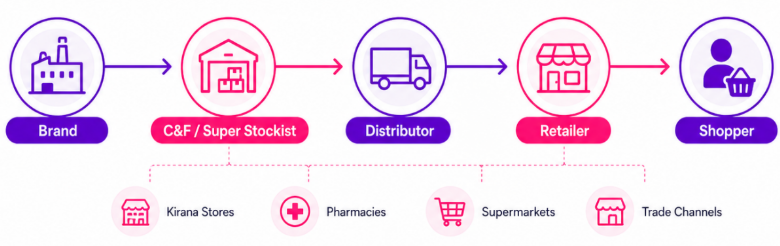
Typical flow: Brand → C&F / Super Stockist → Distributor → Retailer → Shopper
Common in: FMCG, CPG, beverages, pharma, consumer durables, building materials
How it works: The brand manufactures the product and sells it in bulk to a carrying and forwarding agent (C&F) or super stockist, who holds regional inventory and supplies distributors. Distributors sell to retailers – Kirana stores, pharmacies, supermarkets, or other trade channels. Retailers sell to the consumer.
| Dimension | Partner-Led | Distribution-Led |
|---|---|---|
| What is sold | Software, services, solutions | Physical consumer goods |
| Who the partner is | Reseller, VAR, consultant, affiliate | Distributor, stockist, C&F agent |
| Transaction frequency | Low to medium | High – daily or weekly orders |
| Transaction size | Typically, large | Typically small, high volume |
| Customer visibility | Partner often owns end-customer relationship | Brand has limited direct retailer visibility |
| Revenue flow | Commission, margin, or resale price | Distributor margin on each invoice |
| Performance measurement | Pipeline, deal value, partner-sourced revenue | Secondary sales, numeric distribution, fill rate |
| Technology used | PRM, CRM | DMS, SFA |
Channel partners differ by industry, role, and commercial relationship. These are the most common types:
Is the distributor a channel partner? Yes – in distribution led companies, the distributor becomes the main channel partner.
In FMCG and CPG businesses, channel sales is the primary go-to-market model. The brand rarely sells directly to the consumer -instead, it moves product through a layered distribution chain, with each layer performing a specific commercial function.
The typical FMCG distribution flow:
Brand (Manufacturer) → C&F / Super Stockist → Distributor → Retailer → Consumer
Primary sales are the sales that the brand makes to the distributor/super stockist. This is the money that the brand earns and the target which the national and regional sales teams of the brand have to meet.
Secondary sales are the sales made by the distributor to the retailer. The most commercially crucial piece of data for the FMCG category comes here because it is based on real market demand, not what was pushed down the channel by the brand.
Tertiary sales are the sales that the retailer makes to the consumer. This is the truest representation of consumer demand, but the most difficult one to get for FMCG as most kirana stores lack digital POS.
These three terms are often used interchangeably but refer to different concepts.
| Term | What It Means | Example |
|---|---|---|
| Channel sales | The strategy of selling through third-party partners rather than directly to customers | An FMCG brand selling through distributors and retailers; a SaaS company selling through resellers |
| Sales channel | The specific route or medium through which a sale is made | General trade, modern trade, e-commerce, direct-to-consumer, telesales |
| Distribution channel | The physical or commercial pathway through which a product moves from manufacturer to consumer | Brand → C&F → Distributor → Retailer → Consumer |
The simplest way to distinguish them: channel sales describes the strategy (using partners). Sales channel describes the route (where the sale happens). Distribution channel describes the physical supply chain (how the product moves).
Channel sales is not universally the right model -and presenting it as such would be misleading. The decision to use channel sales, and how extensively, involves real trade-offs.
Benefits:
Trade-offs:
Channel conflict occurs when two or more parties in a distribution network compete against each other in ways that damage one or more partners’ commercial interests.
Why it happens:
| Cause | Warning Sign | Possible Control |
|---|---|---|
| Direct vs channel overlap | Brand sells directly to key accounts that distributors also serve | Define clear account ownership rules and communicate them to both sides |
| Partner vs partner territory overlap | Two distributors covering the same outlets or geography | Clearly defined and enforced exclusive territories |
| Pricing inconsistency | Different partners selling at different prices to the same customer type | Enforce uniform trade pricing with clear scheme structures |
| Scheme design conflicts | Retailer incentives that bypass the distributor | Design schemes that include distributor participation or clearly exclude them from the flow |
| Communication gaps | Partners learn about new pricing or scheme changes from retailers rather than the brand | Proactive, simultaneous communication to all channel tiers before market-level changes take effect |
| Incentive misalignment | Partner incentives that reward volume over execution quality | Build scheme structures that reward the behaviours the brand actually needs, not just shipment volume |
Channel sales KPIs differ significantly depending on whether the business is running a partner-led or distribution-led model.
Partner-led channel KPIs
Distribution-led channel KPIs
A channel sales strategy is the set of decisions and practices that govern how a brand recruits, enables, manages, and measures its channel partner network. This framework applies to both partner-led and distribution-led models, with adaptations for each.
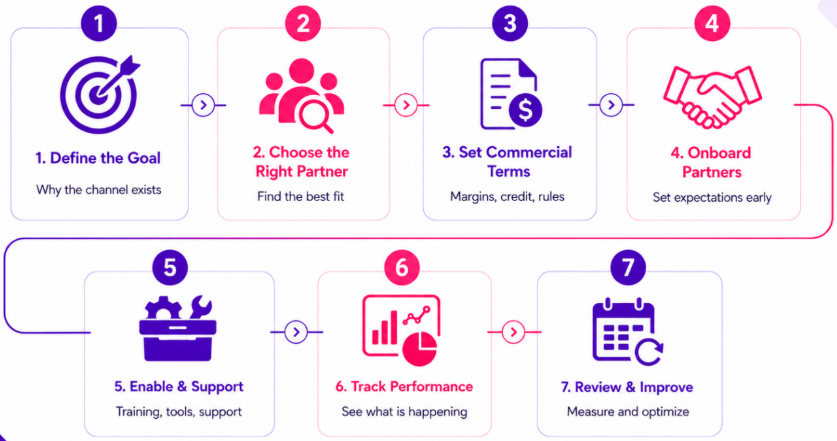
1. Define the channel’s purpose
Determine what your channel should be accomplishing: geographic reach, customer group access, penetration, speed, cost savings? Your channel’s purpose dictates the type of partner you need and what needs to be measured.
2. Choose the ideal channel partner
Not all prospective partners are the right ones for the job. In distribution-led companies, this translates to an assessment of reach, relationships with retailers, working capital, and readiness to provide secondary sales data. In partner-led companies, it translates into customer fit and capability complementarity.
3. Specify commercial terms
This includes margin arrangements, credit terms, scheme participation, minimum performance criteria, and exclusivity, all prior to partner appointment. Unclear commercial terms lead to disputes which prove extremely hard to solve once the partnership is established.
4. Partner recruitment & on-boarding
On-boarding your partners is where the quality of the execution is made or broken. If your distributor is not clear about your company’s scheme structure, territory expectations, and reporting requirements, he will not perform well right from the beginning. If your IT reseller cannot explain the value proposition of your product, he will not make any sales.
5. Enable and empower partners
The performance of partners is improved by giving them access to product training, marketing collateral, scheme data and operational assistance. For distribution-led models, enabling partners is about giving distributors the tools and commercial help to execute their market coverage plans.
6. Build visibility on channel performance
Any channel strategy without performance visibility is just wishful thinking. For partner-led models, it is all about a PRM solution with deal registration, pipeline management and partner performance reporting. For distribution-led models, it is all about DMS and SFA that captures secondary sales, outlet coverage and distributor performance data.
7. Evaluate performance regularly
The performance of channels has to be evaluated in the correct timeframe for the business. Secondary sales and outlet coverage in FMCG must be evaluated every week while partner pipeline and deal conversion in B2B must be evaluated monthly.
Channel sales works well when:
Customers are widely distributed and expensive to reach directly
Direct sales works better when:
Many businesses find that a hybrid model -direct for strategic accounts, channel for broader coverage -delivers the best commercial outcome. The question is not whether channel sales is good or bad, but whether it is the right structure for a specific customer segment, geography, or commercial objective.
The technology used to manage channel sales differs significantly between the two models.
Channel Sales Led by Partners: PRM and CRM Tools:
PRM software facilitates the partner sales cycle -from recruitment and on-boarding, deal registrations, lead sharing, partner enablement, incentive and performance management. CRM integration allows partner-driven deals to be recorded in the same pipeline view along with other direct sales.
Channel Sales Led by Distribution: DMS and SFA Tools:
Distributor Management System captures all secondary transactions, inventory of distributors, scheme implementation, and claims processing -enabling brand visibility through the distribution layer beyond primary invoicing’s software links field rep activity to DMS -recording outlet visit information.
Botree Software RTM platform is built specifically for distribution-led channel sales -with DMS, FlexiDMS, SFA, van sales automation, and a retailer ordering app that together give FMCG and CPG brands real-time visibility into secondary sales, outlet coverage, and distributor performance across their channel network.
While channel sales might appear to be nothing more than an addition of extra partners for the purpose of reaching more customers, in reality, it is a matter of developing a channel ecosystem in which all partners have well-defined roles and adequate levels of motivation and transparency.
In case of partner-led companies, this could involve managing resellers, alliances and partner pipelines. In case of distribution-led companies like FMCG, this will entail coordination of distributors, field forces, retailers, inventories, and secondary sales.
As channel networks get more complex, the focus moves from development of reach to management of reach.
Those businesses who succeed in this task will be able to see what is happening inside the channel, react quickly to changes in the market conditions, and consistently enhance product distribution.
This is where channel sales go beyond a route to market becoming a growth engine.

Marketing Associate
Meet Christina Evangelin Ebinezer, our dynamic marketing associate at Botree Software. With a background in HR and marketing, and prior experience as a content writer, Christina brings a sharp eye for storytelling and a knack for crafting engaging blogs and marketing content. She’s passionate about turning ideas into words that drive impact. Outside of work, Christina finds joy behind the piano keys or the wheel—whether she’s playing a soulful tune or cruising down open roads.
What do you mean by channel sales?
Is channel sales B2B or B2C?
What is the difference between sales and channel sales?
What are the types of channel partners?
Is a distributor a channel partner?
What is channel sales in FMCG?
How do you measure channel sales?
What causes channel conflict?
Stay updated with the latest trends and insights.