
Botree DMS
Streamline distribution and boost primary sales efficiency.

Botree FlexiDMS
Access secondary data seamlessly without daily disruption.

Botree MyDMS
Empower distributors and accelerate rurban market growth.

Botree SFA
Boost sales productivity and ensure in-store excellence.

Botree Retailer App
Enhance retailer engagement with modern mobile app.

Botree AI
Make smarter decisions with granular insightful dashboards.


Christina Evangelin Ebinezer
Marketing AssociateUpdated on June 2, 2026



Every FMCG and CPG sales team asks themselves the exact same two questions at the end of each week: Are we getting to all the outlets we are supposed to be? Are our people getting the maximum out of every visit they make? Sales force tracking systems have been developed to assist in answering precisely those two questions.
When done right, sales force tracking enables more targeted guidance for the salesperson, better visibility for their managers, and a metric for measuring how successful a company has been in ensuring both adequate outlet coverage and high levels of activity of its salespeople. This is no spy gadget; it is a support mechanism.
This blog walks through what modern sales force tracking is, the five specific ways it helps teams improve outlet coverage, the five specific ways it helps teams improve team productivity, the mistakes that quietly sabotage both, the seven features to look for in any sales force tracking software, and how Botree SFA is helping leading consumer brands put it all into practice.
Sales force tracking refers to the process whereby all significant activities of a sales force in the field are tracked, verified, and analyzed. These include calls, beats, attendance, call duration, order acquisition, implementation of any marketing programs and schemes, merchandizing verification, and execution within outlets. Sales force tracking in the modern world goes beyond just collecting GPS information and marking attendance records. It provides the basis upon which signals are created to guide decisions in the following day.
There are two key goals that all teams would like to achieve through sales force tracking.
Outlet Coverage refers to the extent of coverage of outlets achieved by the company’s marketing team; whether the extent of outreach is adequate, the degree of regularity achieved, and the manner with which all beats are covered. Outlet coverage is thus the backbone of distribution.
Team Productivity pertains to what is accomplished within the context of outlet coverage across all the field team. This is evident through strike rates (percentage of visits that produce orders); lines per call or LPC (number of stock keeping units sold per call); average order value (AVO); selling time efficiency; SKU stocking level at all outlets; and managerial ability to coach salesperson on improving their productivity.
You can’t grow with one without the other. High outlet coverage without team productivity means salesperson are touching every outlet but selling nothing meaningful at each. High team productivity without outlet coverage means a handful of strong outlets carrying the whole region. The teams that lift both at once are the ones that grow consistently — and modern sales force tracking is what makes it doable.
Outlet coverage is about reaching every outlet you should be reaching – at the right frequency, with no gaps left unattended. Five things sales force tracking does to make this real on the ground.
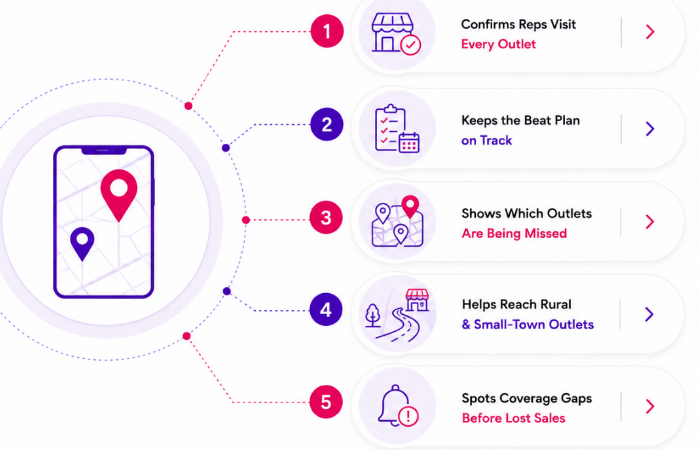
The modern technique of verification through GPS, geo-fencing, and selfie validated check-ins ensures that the salesperson has been present in the store. Finally, you have numbers in the dashboard that reflect what is happening. No more assumptions. No more exaggerated results.
Daily journey of every salesperson, which is called a Permanent Journey Plan, or PJP, is monitored and compared to the number of visits. The missed stores become evident at once. Your salesperson stays in their tracks due to the system monitoring every deviation.
Live maps show all stores within your universe – billed/unbilled, dormant, and new. Outlets that haven’t been visited in 14, 30, and 60 days appear prominently. Sales managers know precisely where their coverage is weak and send sales salesperson to plug any holes while their competitors are unaware.
With tracking software offering offline support, and intelligent route optimization, the effort of an entire team stretches to rurban and Tier 2/3 marketplaces – places that are too expensive to be covered using a traditional daily routine. It penetrates further into rural areas without the need to hire more personnel.
AI powered outletpluse tools monitors your outlet coverage and warns you immediately about any issues – high-potential kirana not visited for 14 days, underperforming beats, and competitive marketing campaigns stealing customers from a certain cluster. It allows managers to address the issue while it’s relatively insignificant.
Team productivity revolves around how effectively the salesperson and managers utilize the available time, by selling more on each call, learning faster, and growing as a team. There are five ways that sales force tracking boosts team productivity.
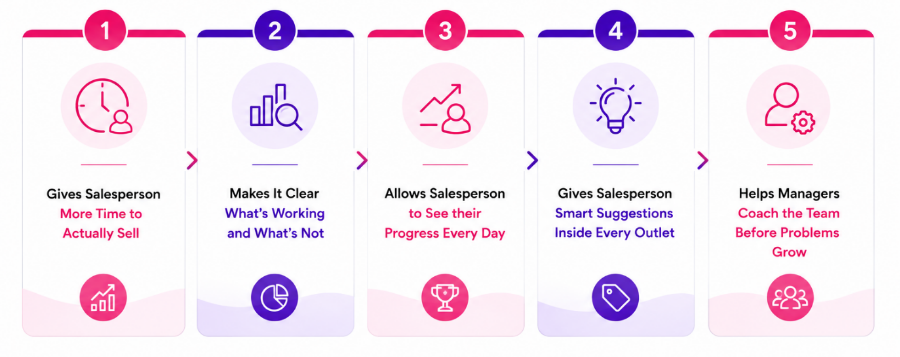
In cases where attendance, navigation, order capturing, and salesperson occur through the same system, a salesperson will save at least one hour that was previously spent doing all these activities by hand each day. The salesperson spends more time selling and therefore generates more orders and more successful visits.
A good sales force management system pays attention to the right metrics, such as orders per visit, SKU per order, average order value, and beat adherence. Productivity discussions are salesperson with a discussion on what should be done differently in the following visit.
Instant feedback in the form of real-time dashboards, leaderboards, and performance-rewarded incentives keeps the salesperson motivated. They know how their numbers stack up against other salesperson and exactly what needs to be done to climb the ranks. The performance of the salesperson becomes more about daily activity than quarterly discussion.
State-of-the-art sales force automation software makes use of AI to prompt the salesperson within the outlet, recommending that they push a certain SKU because it has been long overdue, suggest a particular promotional plan as it is active for that type of outlet, or highlight a new product launch owing to the fact that the previous visit generated low sales numbers.
The monitoring system provides the managers with all the necessary coaching information. If a salesperson’s strike rate dips over a period of two days, or a high-value outlet is overlooked, the manager notices it instantly and offers some advice or guidance to improve the situation.
Even well-resourced sales organizations fall into the same traps.
Not every “tracking app” is built for the FMCG and CPG reality. When evaluating sales force tracking software, look for these seven non-negotiables.
Apart from mere check-ins, sophisticated systems need to verify that the salesperson is at the location itself using real-time tracking via geo-fencing and selfie confirmation to rule out any attempts at using older selfies.
Beat routes are important. The most sophisticated solutions are the ones where the platform constantly sequences outlets based on a number of variables like past due accounts, stocked-out accounts, traffic patterns, and other real-time information.
For Rurban or Tier 2/3 beats, internet connectivity is poor. The system must therefore work offline until the moment when connectivity is restored after which it must sync seamlessly to avoid any losses.
Tracking that does not integrate with the order process realizes only 50% of its potential. All processes that the salesperson uses for check-in need to be integrated for capturing orders, applying schemes, and updating inventory – all of which need to be done in real-time.
Moving tracking from just salesperson to tracking as coaching is the key differentiator in 2026. Expect features such as AI Product Recommenders, scheme matches, and outstanding outlet alerts while making the visit.
Salesperson productivity is optimized most efficiently by having the ability to view one’s performance on an outcome basis, compete against peers, and get rewarded based on outcomes achieved.
Sales Force Tracking that remains isolated from other systems will always result in siloed information. It should integrate seamlessly with the rest of your stack – DMS, Retailer App, and Analytics.
Botree SFA is the engine behind sales force tracking and automation of Botree Software’s AI-based RTM platform, which serves more than 100 of the most prominent FMCG/CPG/Consumer Durables/OTC Pharma brands in India and emerging markets. It is part of Botree Software’s end-to-end connected stack consisting of Botree DMS, Botree Retailer App, and Botree Insights.
There are several practical applications of the Botree SFA system in the context of sales force tracking.
Sales force tracking in 2026 cannot be done in the old way by simply checking in on salespeople and their outlet visits. Today, sales force tracking needs to improve beat execution, enhance sales force efficiency, increase outlet visits, and improve decision-making throughout the sales cycle.
In today’s highly competitive environment for FMCG/CPG products, it makes sense to adopt intelligent sales force automation software solutions like Botree SFA, which enables better beat execution, enhances outlet visits, increases field productivity, and drives better decision-making based on salesforce tracking.
The brands of the future will have to do much more than track their sales force – they will have to enable smarter sales performance from each and every outlet visit.
Marketing Associate
Meet Christina Evangelin Ebinezer, our dynamic marketing associate at Botree Software. With a background in HR and marketing, and prior experience as a content writer, Christina brings a sharp eye for storytelling and a knack for crafting engaging blogs and marketing content. She’s passionate about turning ideas into words that drive impact. Outside of work, Christina finds joy behind the piano keys or the wheel—whether she’s playing a soulful tune or cruising down open roads.
What is sales force tracking in FMCG and CPG?
Why is sales force tracking important for FMCG brands?
How does Sales Force Automation (SFA) improve field sales management?
How does AI improve sales force tracking and field execution?
What features should businesses look for in sales force tracking software?
How does sales force tracking improve retail execution?

Stay updated with the latest trends and insights.