
Botree DMS
Streamline distribution and boost primary sales efficiency.

Botree FlexiDMS
Access secondary data seamlessly without daily disruption.

Botree MyDMS
Empower distributors and accelerate rurban market growth.

Botree SFA
Boost sales productivity and ensure in-store excellence.

Botree Retailer App
Enhance retailer engagement with modern mobile app.

Botree AI
Make smarter decisions with granular insightful dashboards.

Christina Evangelin Ebinezer
Marketing AssociateUpdated on June 4, 2026



Without question, the territory represents the basic unit of work in any sales-led business. Salesperson starts the day by getting a set of assigned outlets, accounts, or regions he/she needs to cover, and at the end of each quarter, results are measured based on territories. Do it right and your representatives have the proper foundation to succeed. If not, the best representatives will fail just like poorly performing territories.
Territory Management is the field that turns the raw geography of markets into a well-organized framework that optimizes sales coverage and increases performance for every salesperson to have all possible means to achieve the peak performance. In this blog, we take a deep look into territory management and its types, how coverage can be increased and sales performances improved, most common mistakes, key performance indicators, how AI is changing the landscape of territory management in 2026 and applications for FMCG, CPG and Consumer Durables brands.
Territory management is the science of breaking down the sales marketplace into small and manageable regions such as geographic territories, accounts, distribution channels, or industries, and allocating salespeople, resources, and objectives for each. Proper territory management would see to it that all outlets or customers receive the proper amount of service, each salesperson’s workload is evenly distributed, and there exists an efficient process of measuring service and effectiveness on the ground level.
When it comes to FMCGs, CPGs, and consumer durables, territory management is the operational level where the service delivery, time allocation of field salesperson, and brand presence in the market is determined.
Successful territory management is not an administrative process. It is the strategic approach which will define whether you will have a team ready to fight and win. Here are six reasons why territory management is becoming ever more crucial for success in 2026.
Each outlet, each dealer and high-profile customer will receive the attention they deserve. There will be no forgotten outlets and no great business opportunities hidden in an area assigned to an underperforming representative.
Effective territory management ensures a proper distribution of workloads among your salespersons. Proper territory management ensures balanced work distribution based on outlet number and sales opportunity for all salespersons.
Well-designed territories minimize unnecessary travel and unproductive sales calls. Salesperson spend their valuable time interacting with potential clients instead of trying to figure out where they should be going next.
When one salesperson is responsible for the entire territory, it becomes the sole contact person for each client. As a result, trust and professionalism increase while competitors’ shelves stay empty.
With territories in place, managers can easily understand which regions exceed expectations, which fail to meet them, and which require additional resources or restructuring.
When a company enters a new market or introduces new products, having a sound territory structure is the only way to make sure that the expansion process goes smoothly.
The seven strategies below work together. Each one either improves how well your team covers the market, how well it performs once there, or both.
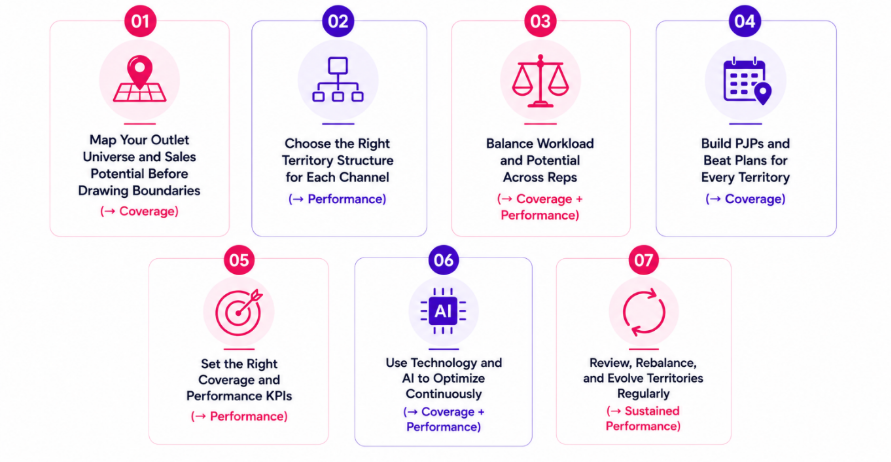
#1 Map Coverage Potential Before Assigning Sales Territories
The biggest error to make when it comes to territories is building the plan around hunches rather than facts. Start by mapping out your entire dealer universe, both billed dealers and unbilled prospects. Add on the sales opportunity by class, channel, and category density. Only then draw territory boundaries.
This approach will ensure that you do not suffer from two of the most common shortcomings of coverage plans, namely having unassigned dealers and valuable dealers within under-prioritized territories.
#2 Choose the Right Territory Structure for Each Channel
Most brands stick to one type of territory structure for everything and silently sabotage themselves by doing so. Geographic territories work well for general trade and kirana distribution. Account territories will be the way to go for modern trade chains and Consumer Durables dealers. In case of FMCG, CPG, and Consumer Durables, a hybrid approach involving channels can be the optimal solution.
Choose the structure suited to the economics of each channel and allow them to coexist in one network.
#3 Balance Workload and Potential Across Salesperson
Equal numbers of outlets do not necessarily equate to equal workload either. There’s a huge difference between a territory having 200 outlets that have high sales potential compared to another that has 200 outlets but lack the sales capacity. Consider both the number of outlets and their sales potentials when establishing balanced territories so no salesman becomes overwhelmed by quantity alone or sandbagged by poor quality. A balanced approach here will increase coverage and performance.
#4 Build PJPs and Beat Plans for Every Territory
Without the existence of a beat plan or Permanent Journey Plan (PJP), a territory remains a region whose name is that of the salesperson involved. The PJP is the one responsible for making a territory become real in terms of its coverage. Each salesperson is assigned daily routing to selected outlets in proper frequency.
#5 Set the Right Coverage and Performance KPIs
Whatever is measured by the manager becomes the focus of the efforts of the team. Ensure that your territory’s score card is based on the right blend of two types of indicators -coverage (coverage, beats adherence, productivity of calls) as well performance (sales conversion rate, lines/call, etc.).
#6 Use Technology and AI to Optimize Continuously
Contemporary territory management depends on technology and not Excel. SFA software monitors planned vs. real-world territory coverage. DMS software collects secondary sales information that is used to measure the performance of territories against Key Performance Indicators (KPIs). However, AI takes this one step further by sequencing visitations in the most efficient way possible, identifying areas lacking coverage.
#7 Review, Rebalance, and Evolve Territories Regularly
Markets change. Outlets come and go. Established markets change too. Distribution channels expand. Competition changes its dynamics. A market that has been planned in January may not be relevant in August. Brands that are best in class look at their markets on a quarterly basis and use artificial intelligence.
Review territories quarterly, not annually. The annual rebalance is too slow for 2026’s rate of market change. Set a quarterly review cadence with clear triggers (coverage drift, performance variance, channel shifts) and rebalance surgically – not in panicked annual overhauls.
Many territory management problems don’t come from poor execution; they come from poor territory design. As markets evolve, even well-established brands can struggle with coverage gaps, resource imbalances, and declining field productivity.
The most successful organizations treat territory management as a continuous optimization process rather than a one-time sales planning exercise.
Territory management has traditionally been more about reacting to situations. Sales leaders had access to data but did something only when there were signs of problems in the numbers – when a territory failed to deliver results, when a salesperson had too much work, or when a vital account was being ignored.
The advent of AI tools changes the paradigm. They help the managers not in understanding why something happened but in identifying current trends and predicting future occurrences.
Three major shifts are reshaping territory management in 2026.
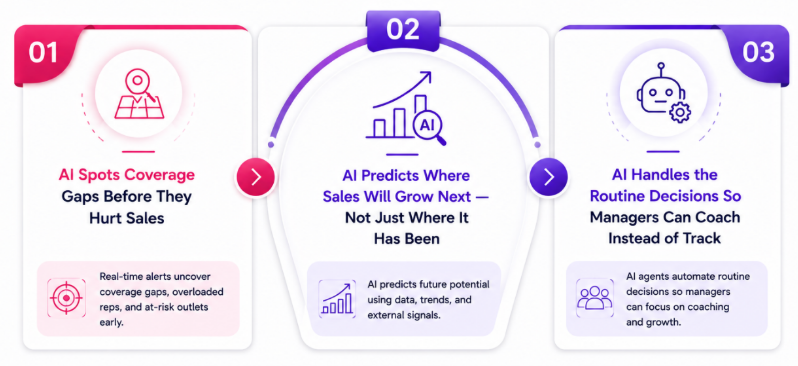
Historically, the presence of these gaps used to be identified only when there was a fall in sales figures. In such a situation, the top-performing outlets would already have had their visits delayed for several weeks, while other competitors might have secured shelf space.
On the contrary, AI always keeps track of all visits, coverage efforts, sales activities, and performances in territories to identify potential risks at once. For instance, if an important outlet has gone unvisited or a particular beat does not receive enough attention, immediate intervention becomes possible. Such a proactive approach helps prevent adverse situations.
Most territory strategies rely on past performance. But the issue with markets is that they don’t develop according to what happened in the previous year.
The AI leverages secondary sales information, density of outlets, demographic shifts, buyer behaviour, patterns in category development, seasonality effects, and other market indicators to determine areas where future growth will likely occur.
In this way, the sales manager gets a forecasted understanding of the potential for each territory. In addition to directing investments towards current high-performing areas, they can now focus their efforts on expanding into rurban markets, developing trading zones, and new territories.
But perhaps the most revolutionary breakthrough in 2026 comes in the form of Agentic AI.
Contrasting with typical analytics solutions that only produce reports, Agentic AI systems can make and execute product recommendations based on preset business rules. It can change the beat priorities, find imbalances in workload, point out poorly performing territories, provide territory coverage adjustments, and even inform representatives about opportunities being lost.
This allows managers to pay more attention to improving results rather than monitoring activities. They get rid of firefighting and are free to work on coaching and growing.
For FMCG, CPG, Consumer Durables, and OTC Pharma, Agentic AI will change the way territory management is approached forever. It goes beyond planning and becomes ongoing optimization of coverage and sales performance.
Effective market coverage requires more than a territory plan. Brands need visibility, execution discipline, and the ability to respond quickly to changing market conditions.
Botree Software AI-powered Route-to-Market platform helps FMCG, CPG, Consumer Durables, and OTC Pharma brands improve field execution through:
By connecting field teams, distributors, and decision-makers on a single platform, Botree SFA and Botree DMS helps brands execute faster, improve market coverage, and gain greater visibility across their Route-to-Market operations.
It’s not only about defining markets or territories or even distributing sales representatives anymore in 2026. It’s all about coverage optimization, workload balance, productivity increase, and adaptation to changing market environments. The companies which stick to outdated static territory plans may encounter a lack of coverage and inefficiency in resource allocation.
With the help of intelligent territory management consisting of territory design based on analytics, beat plan and PJP execution, constant performance tracking, and AI-driven optimization, the brands will be able to convert this process into a strategic one and use it as their competitive advantage.
Marketing Associate
Meet Christina Evangelin Ebinezer, our dynamic marketing associate at Botree Software. With a background in HR and marketing, and prior experience as a content writer, Christina brings a sharp eye for storytelling and a knack for crafting engaging blogs and marketing content. She’s passionate about turning ideas into words that drive impact. Outside of work, Christina finds joy behind the piano keys or the wheel—whether she’s playing a soulful tune or cruising down open roads.
What is FMCG sales territory management, and why is it critical for sales growth?
How can territory planning and territory mapping improve sales coverage and productivity?
What are the biggest territory management challenges facing sales teams today?
How does territory management software support sales territory optimization?
What are the benefits of AI-powered territory management and predictive sales planning?
How do sales force automation and beat planning improve field sales management and retail execution?





Stay updated with the latest trends and insights.