
Botree DMS
Streamline distribution and boost primary sales efficiency.

Botree FlexiDMS
Access secondary data seamlessly without daily disruption.

Botree MyDMS
Empower distributors and accelerate rurban market growth.

Botree SFA
Boost sales productivity and ensure in-store excellence.

Botree Retailer App
Enhance retailer engagement with modern mobile app.

Botree AI
Make smarter decisions with granular insightful dashboards.

Christina Evangelin Ebinezer
Marketing AssociateUpdated on August 20, 2026



The demands on field teams have become greater than ever before – greater outlet coverage, faster operations, higher visibility, capturing orders, responding to changes in the market environment and much more.
Low productivity is rarely due to a lack of effort. Across industries, valuable time is wasted due to inefficient route scheduling, cumbersome reporting processes, disjointed systems and inefficient field operations.
This is where field force management Software becomes critical.
Today’s field force management is not just about tracking performance – it’s about driving results through better planning, greater visibility, process integration and improved decision making.
In this guide, we’ll examine how companies can optimize their field productivity, boost field productivity and create more efficient field operations by 2026.
Field force management refers to the act of planning, managing, tracking, and optimizing the actions of field forces to ensure efficient operations and effective results.
This practice assists companies to manage their field operations in different territories, outlets, channels, and processes.
A strong field force management process helps answer critical questions:
In industries such as FMCG and CPG, effective field team management directly influences market coverage, retail execution, and revenue performance.
These terms are often used interchangeably but focus on different outcomes.
| Function | Primary Focus | Example |
|---|---|---|
| Field Force Management | Managing overall field execution and productivity | Beat plans, tracking, outlet coverage |
| Field Sales Management | Improving selling effectiveness and sales outcomes | Orders, conversion, account growth |
Think of it this way:
Field force management improves how work gets done.
Field sales management improves what results that work delivers.
For many years, field performance was evaluated through basic measures of activity such as the number of visits completed, markets visited, or hours spent on the ground.
However, activity doesn’t always translate into results.
Today, leading organizations have begun to focus on better execution rather than more activity. The key is to make sure that every visit to the field contributes to sales, presence, distribution, or customer relations.
High-performing field teams increasingly focus on:
The goal is no longer to maximize activity.
The goal is to maximize the value created by every salesperson visit.
That shift is turning field productivity into one of the biggest competitive advantages in modern field force management.
Field Force Management is the connector for planning and action. It allows organizations to have more visibility, control, and coordination in their field operations while helping employees concentrate on actions that make an impact.
The result is not just better field activity, it is higher productivity, stronger execution quality, and more effective field operations.
Smarter Field force management does not mean increased activity; it means creating more value from each field-based activity. The key point about the pillars is that they all include a particular ability to execute as well as a tangible result for measuring productivity.
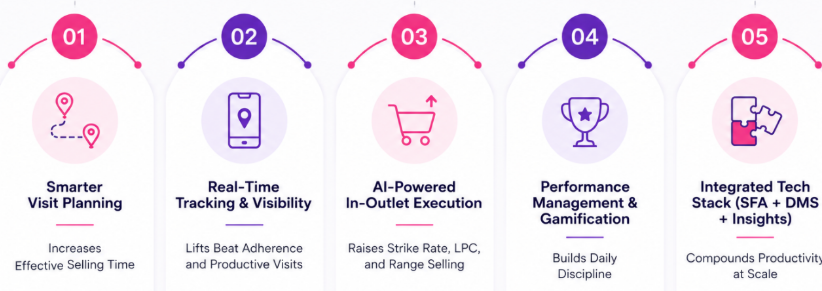
Pillar 1: Smarter Visit Planning → Increases Effective Selling Time
Every successful working day begins with a well-thought-out plan.
The advanced concept of beat planning and PJP includes consideration of the outlet’s potential, number of visits, territories covered, and time saving. AI is actively used in assisting in the dynamic priority setting according to field conditions changes.
Outcome:
Faster travel. More effective visits. More sales and executions.
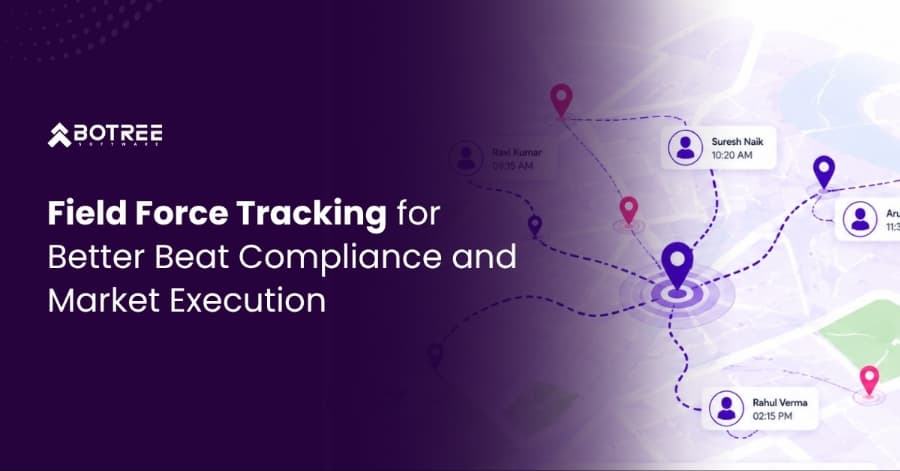
Pillar 2: Real-Time Tracking and Visibility → Improves Beat Adherence and Visit Quality
Performance is enhanced by making execution visible.
The modern field force management systems make use of live visibility, geo-verified visits, attendance management, and execution monitoring to enable the manager to see field activities as they take place.
Outcome:
Increased beat adherence, enhanced visit effectiveness, and better execution discipline.
Pillar 3: AI-Powered In-Outlet Execution → Improves Productivity Per Visit
Productivity is frequently achieved within the outlet.
AI-powered recommendations assist in prioritizing products, selecting product assortment, maintaining stock levels, and executing schemes better owing to the outlet context.
Outcome:
Achieving higher conversions and better executions after each outlet visit.
Pillar 4: Performance Management and Gamification → Builds Consistent Execution Habits
Greater efficiency is achieved with visibility and actionability of performance.
With performance dashboards, objectives, rewards, and smart nudges, organization can monitor their progress toward becoming better at execution.
Outcome:
Greater consistency, swifter improvements, and higher team engagement.
Pillar 5: Connected Technology Stack → Scales Productivity Across Teams
Individual productivity improvement will not have much effect on the overall system.
Linking SFA, execution systems, analytics, and operational data will make the decision process faster and easier.
Outcome:
Productivity extends beyond individuals to become an integral part of the operation model.
Together, these five pillars help organizations move from managing field activity to improving field productivity, execution quality, and business outcomes at scale.
AI in field sales not sonly involve organizing field functions, but also contributes to better execution performance, productivity, and speedier reactions to market developments.
Through improved planning, increased visibility, connected execution, and informed decision making by artificial intelligence, organizations drive tangible business results through field execution.
For higher field productivity, visibility or tracking isn’t enough. It all comes down to how efficiently planning, execution, decision-making, and operations in the field are done.
Botree Software helps organizations bring together Sales Force Automation (SFA), retail execution, field visibility, and AI-driven recommendations into one connected field execution ecosystem.
Higher efficiency in planning, prioritization, execution, and responsiveness will be achieved through this process.
By connecting planning, execution, and intelligence, Botree helps organizations move from managing field activity to building a more productive and scalable field force.
Field teams have never had such responsibilities but simply adding more activities will not deliver better results.
In today’s world, the approach to executing field activities is evolving and shifting from just field execution towards better field force management in order to become more productive and generate more business value from every market interaction.
Thanks to better planning, visibility, connectivity, decision making, and proper technological solutions, companies can enable field teams to spend less time handling operations and instead focus on delivering business results.
And here Botree Software comes into play as it allows to combine SFA, retail execution, field visibility, and AI-based intelligence into an execution ecosystem allowing for quicker decisions and more efficient field operations.
We are not talking anymore about the shift from the manual execution to digital one.
But we are talking about the evolution from measuring activities to becoming more productive.
For FMCG, CPG, and OTC companies, there is a clear way ahead: make your field force fast and smart with efficient execution in mind.

Marketing Associate
Meet Christina Evangelin Ebinezer, our dynamic marketing associate at Botree Software. With a background in HR and marketing, and prior experience as a content writer, Christina brings a sharp eye for storytelling and a knack for crafting engaging blogs and marketing content. She’s passionate about turning ideas into words that drive impact. Outside of work, Christina finds joy behind the piano keys or the wheel—whether she’s playing a soulful tune or cruising down open roads.
What is field force management, and how does it improve field productivity?
What is the difference between field force management and field sales management?
How do beat planning, territory management, and route optimization improve field performance?
How do AI for field sales and field force automation improve execution?
What technology supports modern field force management systems?



Stay updated with the latest trends and insights.