
Botree DMS
Streamline distribution and boost primary sales efficiency.

Botree FlexiDMS
Access secondary data seamlessly without daily disruption.

Botree MyDMS
Empower distributors and accelerate rurban market growth.

Botree SFA
Boost sales productivity and ensure in-store excellence.

Botree Retailer App
Enhance retailer engagement with modern mobile app.

Botree AI
Make smarter decisions with granular insightful dashboards.

Christina Evangelin Ebinezer
Marketing AssociateUpdated on September 18, 2026



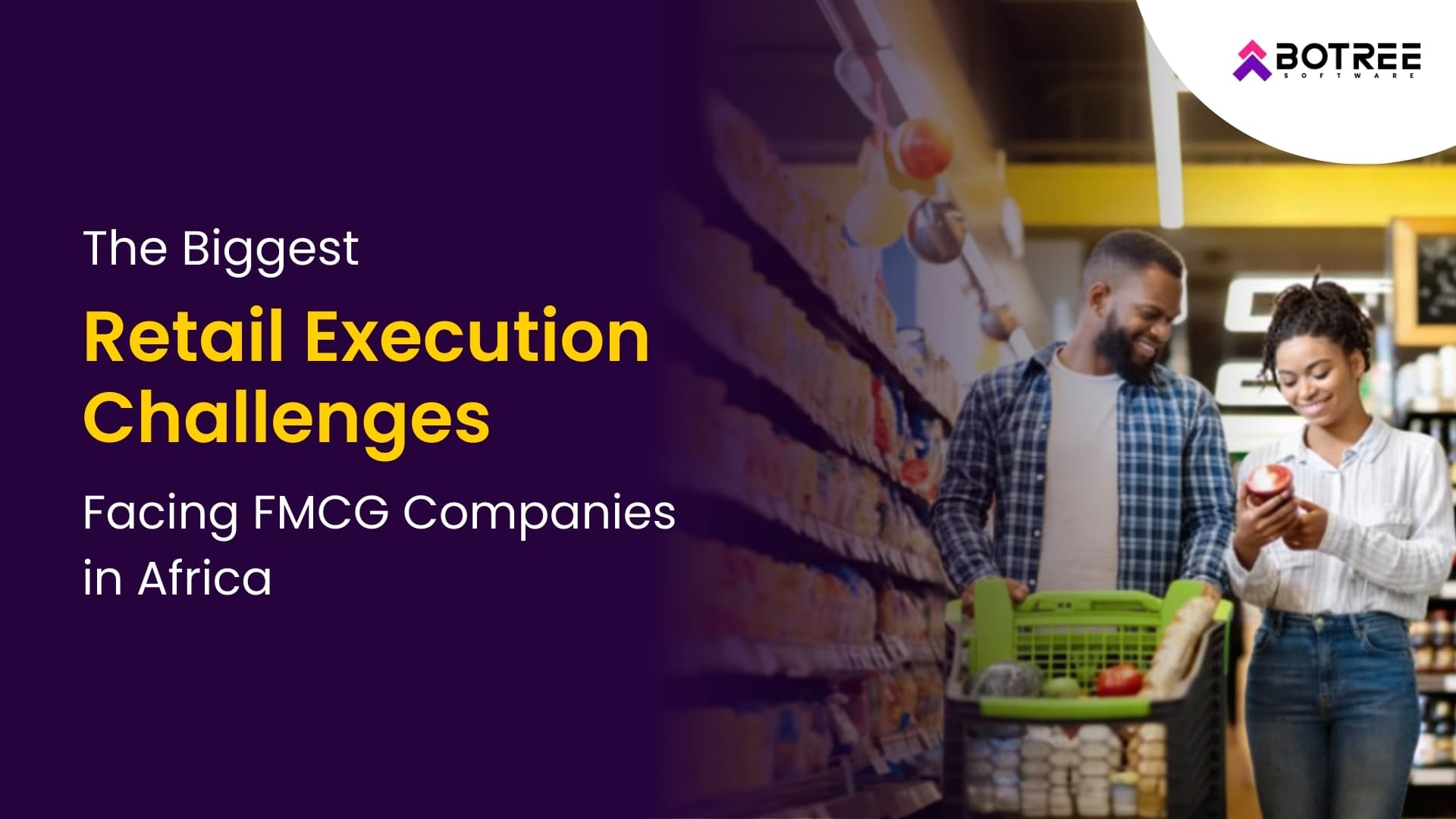
Walk through an open-air market in Lagos or visit kiosks in Nairobi, and you’ll see retail execution in Africa happening every day. Traders serve hundreds of customers daily. Shelves move quickly. Orders happen right away, sometimes through WhatsApp and sometimes from memory. This system keeps FMCG distribution going, even when roads are bad and electricity is spotty.
Africa’s retail sector meets over 80 percent of daily consumer needs through traditional trade. However, stockouts, missed deliveries, and poor shelf availability cost FMCG companies billions annually. Retail audits occur infrequently, and retail visibility across Africa remains limited. This is the retail paradox.
The opportunity is huge. Consumer spending in Africa is expected to reach $2.5 trillion by 2030. Still, traditional trade makes up about 65 to 75 percent of retail sales. Market fragmentation continues to be a challenge. Once you go outside major cities, the route to market is tougher to manage and harder to quantify.
For FMCG brands, having scale doesn’t mean having control. Supply chains become stretched. Decisions about the route to market become more complicated. Manual execution cannot meet the rising demand. This brings up a key question. Can FMCG companies tackle retail execution challenges with tools like sales force automation and DMS, or will execution gaps keep hindering growth across Africa?
Retail execution challenges in Africa stem from structural and environmental issues. These challenges affect cost, control, and growth throughout FMCG distribution.
As FMCG distribution expands into new areas faster than public infrastructure can support. Many roads remain unpaved or poorly maintained, particularly outside urban centers. Seasonal rains make routes impassable. The electricity supply is unreliable, impacting warehouses, cold rooms, and distributor depots. Many operators depend on generators, which raises operating costs and causes downtime.
Impact
Distribution costs increase significantly due to fuel use, vehicle repairs, and longer delivery cycles. Lead times become unpredictable. Missed deliveries rise, and cold chain breakdowns affect the quality of food and beverages. Stock availability declines in rural and peri-urban areas These conditions weaken retail visibility Africa wide and make consistent retail execution Africa difficult to sustain.
Traditional trade continues to dominate daily consumption in Africa. Most outlets are family-owned, cash-based, and unregistered. They operate without inventory systems or sales records. To grow, FMCG brands rely on various distributor and sub-distributor models. Each operates with different levels of discipline and reporting.
Impact
The route to market in Africa becomes complex and costly to manage. Price consistency breaks down, and promotions are uneven. Retail audit coverage struggles to keep up with outlet growth. Retail visibility across Africa remains limited, leaving brands unaware of real shelf conditions. Problems are often identified late, after revenue has been lost.
Many African economies rely heavily on imports and foreign currency. Import dependence exposes FMCG distribution to exchange rate swings. Inflation rises as higher costs move through the supply chain, and consumer incomes do not keep up with price hikes, particularly in essential categories.
Impact
Purchasing power declines, forcing consumers to downsize packs or cut back on purchasing. Demand patterns quickly shift across regions. Promotions lose effectiveness as prices change mid-cycle. Forecasting becomes unreliable, and margins shrink across FMCG distribution, increasing pressure on retail execution Africa teams.
As outlet coverage expands, sales teams manage more stores without better tools. Order taking, reporting, and collections remain manual. Data is often captured late, if at all. Supervisors lack real-time visibility into field activities and store conditions.
Impact
Errors multiply when scaled. Stockouts rise when demand signals are missed. Overstocking follows when outdated data drives replenishment. Deliveries are delayed due to poor coordination, with rural and underserved areas suffering the most. Without sales force automation, execution costs increase while control weakens.
Political instability and social unrest disrupt the movement of goods and people. Regulatory environments change quickly, often without clear timelines. Foreign exchange controls restrict access to hard currency and delay supplier payments. Compliance requirements differ by country and region.
Impact
Transport routes close unexpectedly, slowing or halting distributor operations. Cash flow tightens due to delayed payments and currency restrictions. Expansion plans are delayed or cancelled, and investor confidence declines. Long-term strategies for the route to market in Africa become more difficult to maintain.
Digital transformation addresses the retail execution challenges that FMCG companies face in Africa. Manual processes cannot keep up with the scale, fragmentation, and volatility that define retail execution in Africa today. Digital tools provide structure, speed, and control where it matters most.
Sales force automation boosts execution at the point of sale. Field teams use mobile tools to capture orders, record visits, and update store information in real time. This cuts down on errors related to paper-based processes. Managers get immediate visibility into field activity, which improves accountability and coverage across traditional trade in Africa.
See how leading FMCG brands strengthen retail execution Africa wide using advanced sales force automation built for fragmented markets.
Distribution management systems enhance FMCG distribution by increasing inventory accuracy and order fulfilment. Distributors gain better control over stock levels across depots and routes. This helps reduce stockouts and overstocks. Route planning gets better, allowing brands to manage complex routes to market in Africa more efficiently.
Digital retail audit tools raise retail visibility across Africa. Sales teams can track availability, pricing, and promotion compliance during store visits. Data flows instantly to central systems, enabling faster corrective action. Retail audit frequency increases without raising operational costs.
These systems also help with decision-making. Real-time data leads to better forecasting, smarter promotions, and quicker responses to market changes. Execution plans fit more closely with on-the-ground conditions, even in highly fragmented markets.
The outcome is stronger retail execution across Africa. Availability improves. Service levels stabilize. Costs go down as inefficiencies decrease. For FMCG companies, digital transformation is no longer just a support function; it is a key execution capability.
How Botree Software unlocks growth through retail execution in Africa
Botree Software helps FMCG brands turn retail execution challenges into measurable growth across Africa. Its solutions are designed for fragmented markets, complex FMCG distribution, and traditional trade in Africa.
Botree SFA enhances last-mile execution. Field teams capture orders, outlet data, and retail audits in real time, even in areas with low connectivity. This improves retail execution throughout Africa and increases retail visibility across thousands of outlets.
The platform supports structured routes to market models by connecting distributors, sub-distributors, and sales teams on a single system. Tracking inventory movement and fulfilling orders become easier, which reduces stockouts and improves service levels.
Integrated retail audit features help brands monitor availability, pricing, and promotion compliance at the store level. Issues are identified early, allowing for quicker action before sales are lost.
As execution improves, growth follows. FMCG brands expand coverage without losing control, improve promotion performance, and scale efficiently. Botree Software makes sure growth remains steady, visible, and sustainable.
See how Botree’s Distribution Management System helps FMCG brands gain tighter control across their route to market.
Retail execution challenges are a key factor for FMCG success across Africa. Fragmented traditional trade, complex market models, and limited retail visibility continue to hinder growth.
FMCG distribution at scale needs more than just reach; it needs control at the point of sale. Without regular retail audits and accurate data, execution gaps remain. Manual workflows and limited sales force automation make it difficult to respond to rapidly changing market conditions.
This is where Botree Software makes a difference. Botree digital tools offer FMCG companies a clear way forward by improving visibility, strengthening execution discipline, and connecting field teams, distributors, and data on one platform. Effective retail execution across Africa relies on systems that reflect real situations, not assumptions.
Brands that invest in execution today are setting themselves up for sustainable growth. In Africa’s retail environment, consistent execution transforms opportunities into results.

Marketing Associate
Meet Christina Evangelin Ebinezer, our dynamic marketing associate at Botree Software. With a background in HR and marketing, and prior experience as a content writer, Christina brings a sharp eye for storytelling and a knack for crafting engaging blogs and marketing content. She’s passionate about turning ideas into words that drive impact. Outside of work, Christina finds joy behind the piano keys or the wheel—whether she’s playing a soulful tune or cruising down open roads.


Stay updated with the latest trends and insights.