
Botree DMS
Streamline distribution and boost primary sales efficiency.

Botree FlexiDMS
Access secondary data seamlessly without daily disruption.

Botree MyDMS
Empower distributors and accelerate rurban market growth.

Botree SFA
Boost sales productivity and ensure in-store excellence.

Botree Retailer App
Enhance retailer engagement with modern mobile app.

Botree AI
Make smarter decisions with granular insightful dashboards.

Christina Evangelin Ebinezer
Marketing AssociateUpdated on October 13, 2026



The order process is the first and final stage in FMCG and CPG fulfillment. The retailer requires 12 SKUs. The salesperson adds 10. The distributor fulfills nine. Finally, eight SKUs make it to the shelves. And before the order has even been filled, your company has lost margin, precious time, and some of its goodwill with the retail partner. This scenario plays out hundreds of times a day in hundreds of distribution centers around the globe, all thanks to inefficient order fulfillment.
Order management is an elegant solution that makes order fulfillment efficient and effective by processing orders quickly while catching every single mistake before it becomes an issue. When not done correctly, order management results in losses at every level, from distributor to retailer.
This guide explains what order management is in the FMCG and CPG context, the specific challenges that hurt fulfillment today, how a modern order management system makes fulfillment faster and smarter, the role of AI in 2026, the business outcomes you should expect, and how Botree DMS is being used by leading consumer brands to run all of it.
The order management process entails the entire journey of ordering, validation, processing, delivery, invoicing, and settling for each order coming through the distribution channel of the brand. This refers to the management of orders received from different channels like field salesperson, retail self-ordering application, order placed through distributors, phone calls, or even WhatsApp chats to make sure all the orders become invoiced and settled without any leakages and delays.
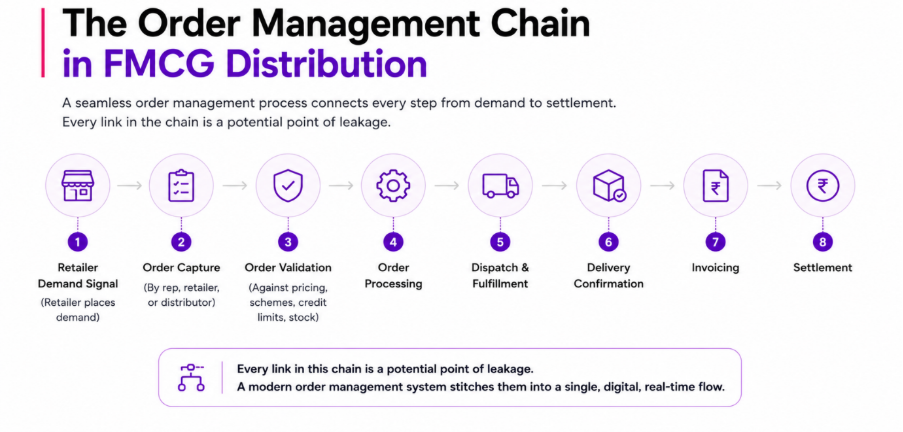
Order management in fast-moving consumer goods (FMCG) and consumer packaged goods (CPG) fundamentally involves integrating the complete order life cycle process, including order creation, verification, processing, delivery, billing, and payment, into an end-to-end digital business process.
A modern order management system helps brands:
Done well, order management becomes the operational backbone that connects sales, distributors, inventory, and finance into a single real-time distribution engine.
Order Management is where the gap between strategy and execution really emerges for most FMCG & CPG brands. Here’s why the below challenges silently erode your top and bottom lines, day by day.
#1 Challenge: Manual order capture and human error.
Brand salespersons still manually place their orders via pen and paper, WhatsApp, or even handwritten notes that are typed up again by the distributor.
Impact: Order accuracy takes a beating. Each mistake results in a return, credit note, or payment delay. Cost-to-Serve goes up for your entire distribution network, making your brand harder to work with.
#2 Challenge: Fragmented order intake across channels.
Your orders are placed through salespersons, retailer platforms, telephonic conversations, WhatsApp, and online portals – all in fragmented ways that don’t integrate.
Impact: Duplicate orders, missing orders, and inconsistent processing are common practice now. Your sales management can’t see one unified view of today’s orders, placed by whom, for whom.
#3 Challenge: Slow order-to-cash cycles
Manually approved processes, invoice by mail, and offline payment tracking make the order-to-cash process take many days or even weeks.
Impact: The cash flow becomes a limiting factor in the distribution process. Working capital should not be present in the distribution channels’ portfolios. The margins across the chain become under increasing pressure. Growth becomes limited by the liquidity rather than by the actual demand.
#4 Challenge: Stockouts and inventory blindness during order processing
The order fulfiller, lacking visibility into the current inventory available to the distributor and/or the warehouse, approves orders that cannot be executed or denies orders which could be executed successfully.
Impact: The retailers receive partial orders or delayed deliveries. Unfulfilled demand remains uncaptured. The commitment made by the brand regarding its distribution becomes silently breached every single time.
#5 Challenges: Scheme and pricing errors during order processing
Pricing schemes used in trade promotions and incentives are extremely complex – class- and SKU-specific, geographical, and temporary.
Impact: Scheme leakage and disputes abound. Trade promotions’ ROI becomes hard to calculate; erroneous claims are resolved while legitimate ones become delayed.
#6 Challenge: Limited visibility of order progress along the distribution chain.
Once the order has been initiated, the question remains – did it go through, was it shipped out, was it delivered? Often, a brand finds out about a problem only when the retail complains.
Impact: The sales team is responding to challenges from days prior – operating in the past rather than in real time. Tensions arise due to lack of communication between distributors and retailers.
#7 Challenge: Offline and low-bandwidth realities in rurban markets
A salesperson in a rurban area is often unable to achieve a stable Internet connection. So is a Kirana shop that sells the brand’s products.
Impact: An order fails to get registered online; an order is never registered at all. In effect, the brand is limited in its penetration capabilities based on availability of the Internet.
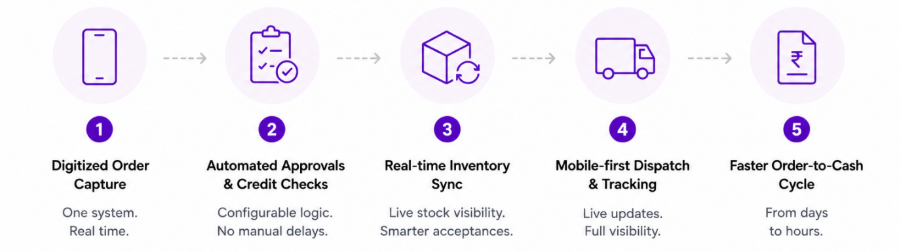
#1 Digitized order capture across every channel: Orders entered by the field salesperson using the Botree SFA app, orders entered by retailers on the Botree Retailer App, or distributors on the Botree DMS all land in one system at once, in real time, no typing, no double-entry, no delays.
#2 Automatic workflow and credit checking process: Orders are processed with pre-configured workflow – credit limit, balance amount, scheme eligibility – without requiring human intervention for routine orders. Distribution becomes smooth.
#3 In real-time, synchronization of inventory: Before processing the order, processors can view distributor’s and warehouse’s real-time inventories. Order acceptance and rejection become less speculative and less cumbersome respectively.
#4 Mobile-based order dispatch and order tracking: As soon as the order gets dispatched, all the updates start coming back into the system as soon as possible. Both the sales head and the retailer know about the order status without any calls or queries.
The cumulative effect is dramatic: order-to-cash cycle times shrink from days to hours, primary sales velocity improves, and the brand’s ability to move stock through the distribution network in response to sudden demand changes goes up several notches
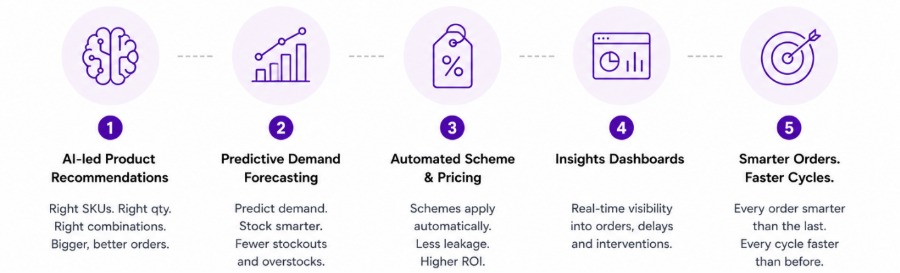
#1 AI-led product recommendations at order capture: The platform recommends the correct SKU, quantity, and combination based on historical orders, current inventory, and active schemes by the retailer. Larger and more optimally balanced orders can be created without requiring additional effort on the part of the salesperson.
#2 Predictive demand forecasting: Order information along with other secondary indicators is used to create models of demand for the following week and month. Better stocking and production decisions are made by the distributor and manufacturer, respectively, with both out of stocks and over stocks being reduced.
#3 Automated scheme & pricing application: Schemes are automatically applied at order placement against the business rules in real time. The number of disputes is reduced, as well as the number of leakages, and ROI from trade promotions can finally be measured.
#4 Dashboards that provide insight based on your order: single order, cancellation, and delayed fulfillment is input into Botree Insights to provide the sales and distribution managers with up-to-the-minute insights.
In 2026, AI technology has shifted from being a functionality within the order management system to be the decision-making layer that dictates what gets ordered, by whom, how, and how quickly. Order management is just the channel – and AI technology is what drives the revolution that takes place via that channel in terms of distribution capabilities. Brands that take advantage of this trend are leading in distribution capabilities every single quarter.
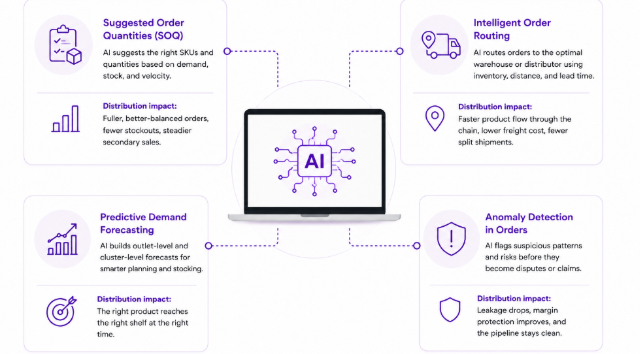
Agentic AI as the next wave. The next evolution is AI agents that handle routine order decisions autonomously – approving eligible orders, applying the right schemes, triggering dispatch, even initiating reorders for high-velocity SKUs. Distributin impact: execution scales beyond human bandwidth. Thousands of orders flow through the distribution network every day without bottlenecks, at speeds human-only workflows can’t match.
When order management is built well and integrated cleanly into the broader sales and distribution stack, the benefits compound across the entire commercial system.
Botree DMS forms the core Order Management Module within the company’s advanced AI-driven Route-to-Market platform designed especially for FMCGs, CPGs, Consumer Durables, and OTC Pharmaceuticals. Alongside other products like Botree SFA, Botree Retailer App, and Botree Insights, it makes up a combined order-to-cash and distribution platform currently being used by more than 100 prominent consumer brands.
The implementation of Botree DMS in managing orders takes on different forms.
“With 2000+ distributors now on board, our DMS has 100% coverage, providing us with invaluable data insights and visibility to boost nationwide sales. The team and product’s ability to handle mass rollouts without any major challenges was appreciable. Kudos to the team for their exceptional performance!”
Ravi Razdan
Director IT & HR, Jyothy Labs Ltd.
Order management for FMCG and CPG products is no longer just an operation process.
Order management has become the crucial component that enables rapid response, visibility, quality service for retailers and market responsiveness.
The evolution of distribution networks in terms of their complexity, involving multiple channels such as General Trade, Modern Trade, e-commerce, quick commerce, and rural distribution, makes traditional manual processes inadequate. Brands require smart and connected order management solutions that enable more efficient order fulfillment, minimize loss, optimize inventory movement, and ensure real-time visibility of the distribution process.
Modern tools for distributing FMCG and CPG products like Botree DMS assist brands in moving from conventional order processes to AI-based distribution solutions.
The winners in 2026 will be the brands who can create
smarter connected and automated distribution systems.
Marketing Associate
Meet Christina Evangelin Ebinezer, our dynamic marketing associate at Botree Software. With a background in HR and marketing, and prior experience as a content writer, Christina brings a sharp eye for storytelling and a knack for crafting engaging blogs and marketing content. She’s passionate about turning ideas into words that drive impact. Outside of work, Christina finds joy behind the piano keys or the wheel—whether she’s playing a soulful tune or cruising down open roads.
What is order management in FMCG and CPG?
Why is order management software important for FMCG distribution?
How does a Distributor Management System (DMS) improve order management?
What role does Sales Force Automation (SFA) play in order management?
How does AI improve FMCG order management and distribution?
What features should businesses look for in order management software?

Stay updated with the latest trends and insights.