
Botree DMS
Streamline distribution and boost primary sales efficiency.

Botree FlexiDMS
Access secondary data seamlessly without daily disruption.

Botree MyDMS
Empower distributors and accelerate rurban market growth.

Botree SFA
Boost sales productivity and ensure in-store excellence.

Botree Retailer App
Enhance retailer engagement with modern mobile app.

Botree AI
Make smarter decisions with granular insightful dashboards.

Christina Evangelin Ebinezer
Marketing AssociateUpdated on August 20, 2026



But what made sense for FMCG & CPG brands back in 2020 isn’t going to cut it in 2026. The change in demand is heading to tougher-to-serve territories. GT used to account for 85% of FMCG revenues until it started getting disrupted by digital kirana stores, modern trade, and quick commerce. And although every FMCG brand has embraced DMS, SFA, and retailer-facing apps, almost all of them face a common issue – data is not being utilized in real time.
The key trend that is shaking up the game in 2026 is AI. AI used to be an add-on to the distribution software; now, it is the technology behind the scenes that drives the process, including timing and reasoning behind each decision within the distribution network. In other words, brands that are leveraging AI to optimize their retail distribution are ahead of the game in terms of market execution: less stockouts, more intelligent schemes, better on-shelf availability, broader rurban penetration.
This blog explains what FMCG retail distribution is, what market execution actually means in 2026, the challenges hurting both today, and the five distinct ways AI is transforming retail distribution to deliver measurably better market execution this year with real-world examples from how Botree AI-powered platform is being used by leading consumer brands.
The term retail distribution refers to the complete process of moving a product of a particular brand to the market via a network of distributors, sub-stockists and retailers, thereby making it available for sale to consumers. The process encompasses the design of the distribution chain (whether direct, indirect or hybrid), the role of all stakeholders involved, order and stock management, schemes/pricing accompanying orders/stocks, and technology used in coordinating and optimizing the entire process. A route-to-market (RTM) strategy specifies the way the distribution will be executed, on each specific channel.
On the other hand, market execution refers to the performance of the actual distribution process on ground. It measures the effectiveness of the distribution process in terms of SKU availability, shelf visibility, shelf share relative to competitors, scheme compliance, sell-in rates and responsiveness to market signals. Market execution performance does not matter when there is no proper retail distribution strategy. In turn, market execution depends on the efficacy of the underlying distribution system.
Together, they form one continuous motion: distribution moves the product, market execution converts it into revenue. In 2026, AI is rewiring both halves at once.
Three forces are converging this year.
Rural India’s FMCG volume grew 8.4% in Q4 FY25 – more than three times the 2.6% urban growth, per industry data cited by Salesforce. Yet most distribution operating models were designed for urban density, not rurban scatter.
Even brands with mature distribution networks lose ground to the same recurring challenges. Each one quietly drains market execution every single day.
#1 Challenge: Limited visibility into outlet-level execution
While the brand understands what is happening with distribution, it lacks insights into retailer/shop-level activity.
Impact: Stockouts, deviation from planogram, and scheme leakage happen unnoticed for weeks. When the brand responds, its competitors have already taken advantage of the situation.
#2 Challenge: Fragmented data across DMS, SFA, and retailer apps
Order data is in one application; beat data – in another one; retailer management is in yet another one, with none communicating in real-time.
Impact: Sales executives take decisions based on incomplete data. Salespersons enters the retail outlet with no understanding of what happened before. Distributors do not see what is going on and respond slowly.
#4 Challenges: Manual planogram and shelf compliance tracking
Audits by field salesperson done via clipboard and memory. What is being measured is not accurate; what is accurate is not being measured.
Impact: Drifting planograms remain unfixed. Shelf promotions by competitors go unnoticed until too late. Trade marketing investments leak to non-compliant stores.
#5 Challenges: Reactive trade promotion management
Campaigns planned centrally, rolled out broadly, and measured slowly. Consistency issues. Return on Investment unclear.
Impact: Trade promotion budgets spent at non-compliant retailers, where the incentive was not necessary, but the compliant retailers who were motivated receive nothing.
Don’t fix one bottleneck without addressing the next one. As Salesforce points out using the Theory of Constraints, when you digitize information flow, the constraint shifts to decision-making. Fix decision-making and it shifts to last-mile execution. Improvements only stick when the entire chain – context, decision, action is unified.
By 2026, AI technology is no longer an individual aspect within the distribution systems. Instead, it becomes the glue that transforms the retail distribution process from a series of sequential actions to autonomous motions. There are five distinct changes currently shaping up market execution in 2016.
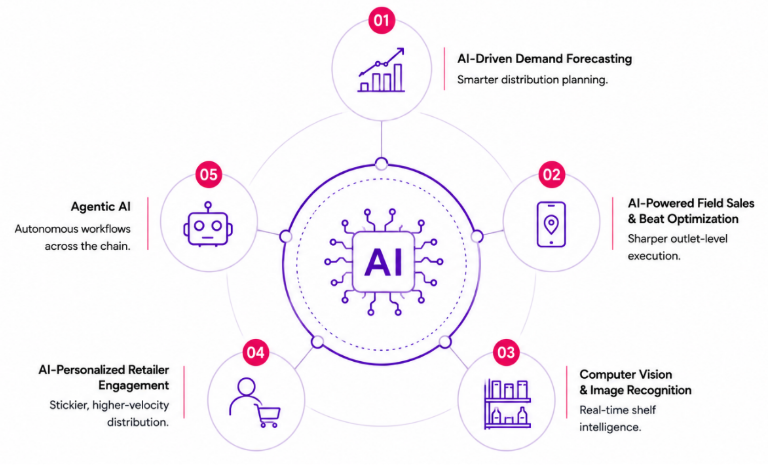
1. AI-Driven Demand Forecasting → Smarter Distribution Planning
Traditional distribution planning has always been based on past sales, intuition, and quarterly updates. This is different for AI as it considers several factors in generating the forecast. Secondary sales, weather patterns, festivals, competitor actions, and buying patterns at the outlet level have been used to generate forecasts in AI.
Impact: There will be appropriate stocking of SKUs. There won’t be out-of-stock situations or excess inventory.
2. AI-Powered Field Sales and Beat Optimization → Sharper Outlet-Level Execution
The 2026 field salesperson enters each retail store accompanied by AI in their pocket. The latest iterations of SFA software leverage AI technology to allow for beat planning and PJP based on real-time situations, show salesperson what the next best action is for each individual store, suggest SKUs that need promotion through technologies such as the AI Product Recommender, and remind salesperson of active promotions and retailers who are overdue.
Impact: Strike rate climbs. Lines per call expand. The same salesperson, in the same outlet, on the same day, sells more.
3. Computer Vision and Image Recognition → Real-Time Shelf Intelligence
Shelf performance determines whether retail distribution delivers value or fails to deliver. By 2026, brand marketers are employing computer vision and image recognition technologies to turn each salesperson’s mobile phone into a shelf monitoring tool. The salesperson takes a picture of the shelf, and AI analyzes it and provides SKU-level insights about what is happening on the shelf right there.
Impact: Planogram drift is corrected on the spot. Competitive actions are discovered within days, rather than months or quarters. Trade marketing activities can now be measured with credibility for thousands of outlets.
4. AI-Personalized Retailer Engagement → Stickier, Higher-Velocity Distribution
The retailer app is no longer an order-taking device. Using AI, it is becoming the engagement tool through which every retailer receives the SKUs, schemes, and suggestions that are the most effective in generating additional orders for them based on their outlet type, region, and buying behaviour.
Impact: Increased order frequency. Schemes are implemented by the appropriate retailers. The brand remains visible all along to the retailer every day rather than just at salesperson visits – thus boosting secondary and tertiary sales.
5. Agentic AI → Autonomous Workflows Across the Distribution Chain
The key evolution for 2026, therefore, lies in transitioning from an advisor-based AI model to an agent-based model. The latest agentic AI systems make routine decisions around distribution automatically qualifying order fulfillment requests, identifying relevant pricing plans, initiating replenishments, and even ordering re-supply for high velocity SKU lines.
Industry have indicated that multiple agentic AI systems can lead to up to 60% fewer errors, 40% faster turnaround times, and reduced operation costs by 25%.
Impact: Distribution in retail happens across a bandwidth much greater than that of any human process; thousands of decisions take place simultaneously.
Botree Software is the AI-powered Route-to-Market platform that ties retail distribution and market execution into a single connected motion. Built specifically for FMCG, CPG, Consumer Durables, and OTC Pharma brands, the platform combines Botree DMS, Botree SFA, Botree Retailer App, Botree Insights, and the Botree AI Product Recommender into one connected stack — used by 100+ leading consumer brands across India and emerging markets.
In real-world deployments, brands use Botree to operationalize each of the five AI shifts described above.
Distribution for retail in 2026 is not merely concerned with shifting goods between various channels. Instead, what it requires is an enhancement in visibility, execution efficiency, retailer interactions, and decision-making across the whole chain.
With the ever-evolving world of FMCG and CPG products, intelligent distribution networks supported through technologies such as AI and automation are needed by brands. Everything from demand forecasting, replenishment strategies to execution in the field and visibility in the secondary market – AI is enabling brands to create faster and more efficient distribution chains.
Modern solutions like Botree assist brands to move away from reactive distribution to AI-supported market execution processes.
Marketing Associate
Meet Christina Evangelin Ebinezer, our dynamic marketing associate at Botree Software. With a background in HR and marketing, and prior experience as a content writer, Christina brings a sharp eye for storytelling and a knack for crafting engaging blogs and marketing content. She’s passionate about turning ideas into words that drive impact. Outside of work, Christina finds joy behind the piano keys or the wheel—whether she’s playing a soulful tune or cruising down open roads.
What is retail distribution in FMCG and CPG?
Why is retail distribution important for FMCG brands?
How does AI improve retail distribution and market execution?
What role does a Distributor Management System (DMS) play in retail distribution?
How does Sales Force Automation (SFA) support retail distribution?
What features should businesses look for in retail distribution software?

Stay updated with the latest trends and insights.