
Botree DMS
Streamline distribution and boost primary sales efficiency.

Botree FlexiDMS
Access secondary data seamlessly without daily disruption.

Botree MyDMS
Empower distributors and accelerate rurban market growth.

Botree SFA
Boost sales productivity and ensure in-store excellence.

Botree Retailer App
Enhance retailer engagement with modern mobile app.

Botree AI
Make smarter decisions with granular insightful dashboards.

Christina Evangelin Ebinezer
Marketing AssociateUpdated on October 12, 2026



The past three years have witnessed more changes in the world of retailing than the preceding thirty years combined. Customers purchase their products through kirana shops, supermarkets, online stores, quick commerce retailers, and brands. Products are moving faster than before. There are new customer demands. Margins are smaller than ever. In this context, the only companies that come out victorious are those that practice modern retail management.
This blog aims to define retail management, identify its key components, highlight its advantages, outline its best practices for the year 2026, and explain why successful consumer brands rely on Botree’s retail management platform for their AI-powered success. We will also explain how FMCG and CPG brands can benefit from effective retail management.
Retail management entails the process involved in the formulation, organization, implementation, and optimization of all activities associated with running a successful retail enterprise. It involves every person, process, technology, and information related to the movement of products from their point of origin to the hands of consumers, alongside everything else about the customer experience.
Where a single retail shop is concerned, retail management may consist of the management of inventory, personnel, customer service, and merchandizing. When it comes to managing a national retail chain, the scope of activities extends to include managing the supply chain process and creating an omni-channel strategy. The case of FMCG and CPG brands involves the unique application of retail management in the management of the distribution channels, sales forces, retailers, campaigns, and on-shelf execution across numerous outlets.
There are three main factors that have increased the complexity of retail management, and also its importance.
Retail management isn’t one thing – it’s a set of seven interconnected functions, each critical to the system’s overall performance.
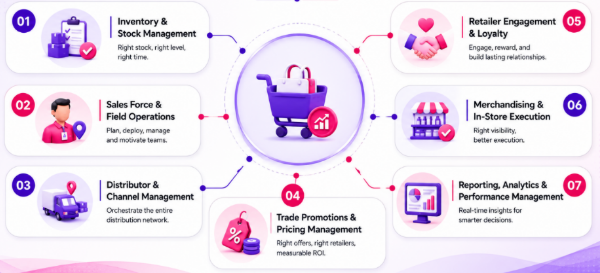
This is the core of the business. Understanding what products are available, where they are located, at what quantity, and the rate at which they flow out of the business. Proper inventory management helps ensure there is a balance between supply and demand and prevents understocking or overstocking of products.
These are the people who ensure retailing happens. The staff working at brick-and-mortar retail stores or field salesperson for FMCG products. This involves proper sales planning, deployment, performance management, training, and motivation management. Good sales force management ensures better outlet reach and sales productivity. Poor salesforce management cripples the entire organization.
This is core retail management for FMCG & CPG brands, where the distributor-sub stockist-retailer network must be managed along with first-, second-, and third-level sale operations, disputes, and ensuring the whole chain follows the same schemes, prices, and inventory movement.
Discounts, schemes, festival deals, and pricing strategy can all be extremely effective, if they are strategic, trackable, and result driven. This function involves crafting the correct scheme for a specific retailer/shopper and implementing it while tracking ROI.
Retailer engagement is crucial because the retailer becomes your customer in this industry. This includes activities like engaging with them using self-ordering apps, loyalty programs, training, and communication that ensure they continue to stock, promote, and sell their product portfolio against those of competitors.
Everything a consumer sees in the store determines his buying behavior. Therefore, this includes the retailer’s adherence to the planogram, share of the shelf, and other related aspects of merchandising execution.
This brings together all the above functions and processes. It involves real-time dashboard reporting, key performance indicators (KPIs) scorecards, and AI-based analytics.
When all seven functions work together, the benefits compound across the entire business.
Better visibility of inventory and management result in improved on-shelf availability of products in front of their target audience. It is estimated that retailers have been losing about 8% sales opportunity due to out-of-stocks only and modern retail operations address that.
By virtue of standardized execution and better auditing processes, shelf presence results in improved retail execution which results in sales growth.
Advanced sales force management combined with execution helps increase the sales productivity per field sales personnel. This is achieved through increased strike rates, line of call and sales productivity metrics.
Reliable fulfillment services, transparent schemes and engagement create trust and hence help maintain channel loyalty.
The use of technology and automation reduces repetitive tasks and optimizes route plans and forecasts.
Better targeted trade and schemes yield higher incremental sales per rupee trade spend.
Real-time insight into sales and logistics helps them make decisions based on data and visibility.
Measure outcome KPIs, not activity counts. Visit counts, call volumes, and audit completion rates feel productive but rarely correlate with revenue. Strike rate, fill rate, perfect order rate, and secondary sales growth are the metrics that matter – and the ones modern retail management is built to lift.
Across hundreds of retail and FMCG & CPG deployments, the same handful of best practices separate the leaders from the other.
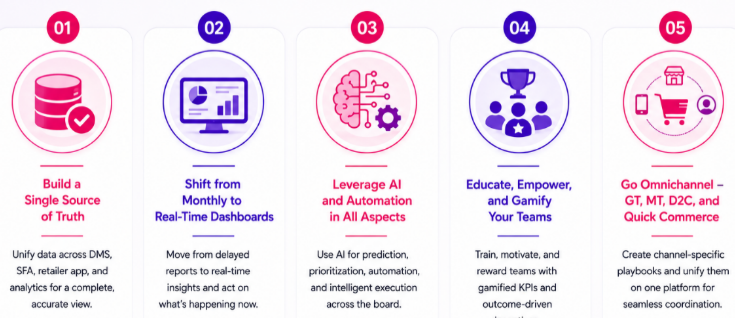
In today’s world, fragmentation is the hidden killer in retail management. Having your inventory data residing on one system, sales data in another, and your engagement with retailers on yet another system creates an incomplete view of the situation. Create unity within your data, and if possible, utilize an integrated solution where you can link up your DMS, SFA, retailer app, and analytics.
Monthly report data is too late for 2026. By the time it is revealed through sales, there have been months where a category slowdown was occurring. Today’s retail management requires real-time dashboards which can reveal gaps in execution on an as-needed basis.
AI is not a tool; it is a technology layer that needs to be integrated into all aspects of retail management from prediction, to visiting prioritization, to the automatic application of schemes and agent-driven order processing, even image recognition for shelf execution. Retailers with AI hard-wired into their systems are leading those who have simply bolted it on.
Retail is all about people. Spend time educating your staff, reward their successes, and utilize gamified KPI dashboards, leaderboards, and outcome-driven rewards to ensure that your teams stay motivated. Motivated teams work more effectively. End of story.
Retail today takes place in multiple channels, and trying to cover all of them at once using the same strategy just isn’t cutting it. Create separate playbooks for General Trade, Modern Trade, HoReCa, D2C, and quick commerce, and coordinate them using one unified platform so they complement each other.
Botree Software helps FMCG and CPG brands manage retail operations, field sales, distribution, and retailer engagement through one connected AI-powered platform.
Retail management in the year 2026 is not just confined to managing retail activities or measuring sales performance. Retail management has now become a networked practice driven by data that influences supply chain effectiveness, retail execution, relationship building with retailers, and market expansion.
With dynamic changes in the distribution process for fast-moving consumer goods and consumer packaged goods, brands need intelligent retail management solutions backed by AI, automation, and visibility. Today, through retail management, companies can enhance efficiency and accelerate their processes throughout every channel.
Botree software provides a platform that helps brands create a connected retail ecosystem through improved visibility and execution capabilities.
Marketing Associate
Meet Christina Evangelin Ebinezer, our dynamic marketing associate at Botree Software. With a background in HR and marketing, and prior experience as a content writer, Christina brings a sharp eye for storytelling and a knack for crafting engaging blogs and marketing content. She’s passionate about turning ideas into words that drive impact. Outside of work, Christina finds joy behind the piano keys or the wheel—whether she’s playing a soulful tune or cruising down open roads.
What is retail management software and how does it help FMCG brands?
How does retail execution impact retail management?
What role does inventory management play in retail management?
How can AI improve retail management and retail analytics?
How do Sales Force Automation and retail management work together?
What features should businesses look for in retail management solutions?
Stay updated with the latest trends and insights.